The rise of remote work has fundamentally changed how we interact with our homes. Today, a home is not just a place to live. It is also an office, a meeting room, a creative studio, a consulting space, and sometimes even a business headquarters. This raises an important question:
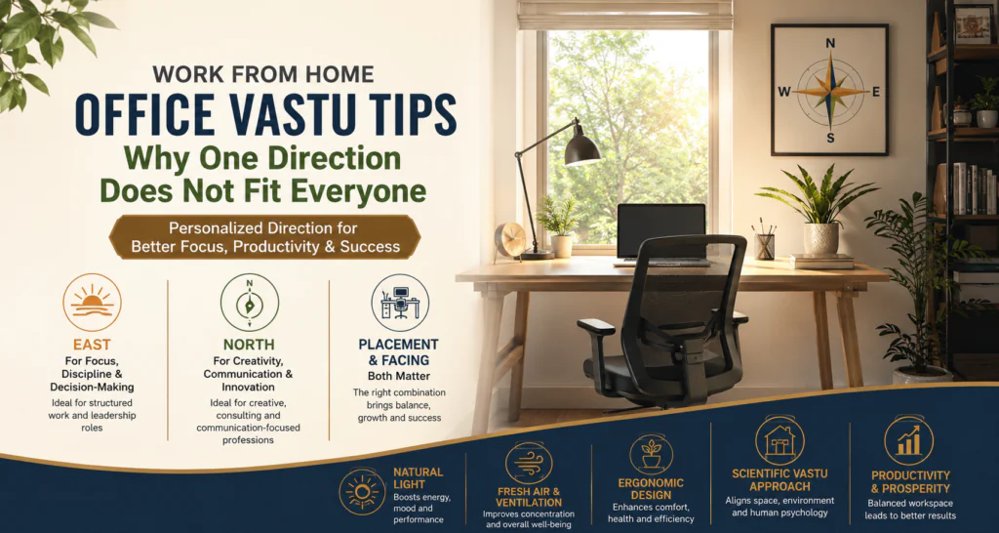
Can one Vastu direction work for everyone who works from home?
According to the Scientific Vastu approach taught at Design Gurukul, the answer is no.
Traditional Vastu literature often associates study, learning, and knowledge with Jupiter (Guru). While this principle remains valuable, the nature of work has evolved significantly. Today’s professionals include software developers, designers, consultants, traders, educators, content creators, researchers, freelancers, therapists, financial experts, and entrepreneurs. Each profession demands a different mental state, working pattern, and environmental condition.
Therefore, before recommending any direction, we must first understand the individual.
Understanding the Person Before the Direction
A successful work-from-home setup begins with understanding:
- The nature of the profession.
- Whether the work requires focus or creativity.
- Day shift or night shift working hours.
- The level of communication involved.
- The duration of daily work sessions.
- The desired output from the workspace.
Only after understanding these factors should, we decide where a person should sit and which direction they should face.
Scientific Vastu aligns human behavior with environmental conditions rather than applying the same rule to everyone.
East: For Focus, Discipline, and Decision-Making
People engaged in structured work often benefit from eastern exposure. This includes managers, administrators, educators, engineers, executives, and professionals responsible for accuracy and decision-making.
The east receives the energizing rays of the rising sun. These rays carry significant photonic energy, providing bright and clear natural illumination that supports alertness and concentration.
In Vedic tradition, the east is associated with Surya and Indra, representing leadership, responsibility, discipline, and authority.
For professionals who work during regular daytime hours and require sustained concentration, facing east can help create an environment that supports clarity and focused execution.
North: For Creativity, Communication, and Innovation
Not every profession requires rigid structure. Many modern careers depend on imagination, communication, strategic thinking, counselling, content creation, and innovation.
For such individuals, the north often proves highly supportive.
Associated with Mercury (Budh) and Kubera in Vedic Vastu, the north is linked with intelligence, communication skills, analytical thinking, and opportunity.
Scientifically, the north receives softer and more diffused daylight, creating comfortable visual conditions for longer working hours. People involved in consulting, design, marketing, coaching, therapy, writing, research, technology, and creative fields often find this environment mentally stimulating and less restrictive.
Night-shift professionals may also benefit from northern placements because their work rhythm differs from conventional daytime schedules.
Placement and Facing: Both Matter
One of the most misunderstood aspects of Vastu is the belief that facing direction alone determines success.
In reality, two factors work together:
- Where you are seated within the house.
- Which direction you face while working.
For example, a financial professional may benefit from a workspace located in the western zone, particularly around W3, W4, or W5 padas, while facing east during work. Similarly, another professional may be seated in the north while facing east to receive the benefits of both placement and orientation.
The final recommendation depends on the individual’s work profile and environmental requirements.
According to the Scientific Vastu principles taught at Design Gurukul, an effective home office involves much more than choosing a favorable direction.
Different professions may require different environmental conditions to support focus, creativity, decision-making, and productivity. The wall visible while working can influence concentration, while daylight quality affects alertness and mental performance. Ventilation, materials, colours, furniture design, and ergonomics all play important roles in physical comfort and overall well-being.
Work-from-home planning should be based on the individual, their profession, work patterns, and specific environmental needs rather than simply locating a desk in a particular zone. The most successful workspace is created when placement, facing direction, natural light, ventilation, interior design, ergonomics, and human psychology function as an integrated system.
In addition, both physical and subtle environmental factors should be assessed. Modern instruments can evaluate measurable conditions, while specialized tools may help study non-physical influences, supporting a healthier, balanced, and high-performance workspace.

No comments:
Post a Comment